When most people think about towing, they picture a car being hooked up and pulled away. With front-wheel drive vehicles, that’s usually straightforward. But all-wheel drive (AWD) and four-wheel drive (4×4) vehicles need special handling.
Tow one of these the wrong way and you’re looking at drivetrain damage. It might not show up right away, but it’ll catch up with you in the form of expensive repairs.
Knowing why AWD and 4×4 systems are different helps you make sure your towing provider handles your vehicle correctly.
Table of Contents
The Mechanics Behind the Risk

To understand why towing affects AWD vehicles differently, you have to look at how the wheels connect. In a standard front-wheel-drive car, the rear wheels are “dead” axles. They spin freely. You could lift the front wheels and drag the rears across the country without a problem.
In an AWD system, all four wheels link through a center differential or transfer case. This component lets the wheels spin at slightly different speeds (necessary for turning corners) while keeping them all powered.
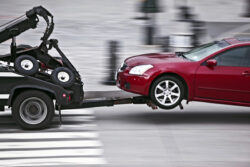
If a tow truck lifts only the front wheels of an AWD car and drags the rear wheels on pavement, those rear wheels start spinning. That movement sends energy back up the driveshaft to the transmission. Because the front wheels are locked in place on the tow truck, the center differential has to absorb the speed difference between the spinning rears and the stationary fronts.
That generates serious heat and friction. With the engine off, the transmission fluid pump isn’t running to lubricate and cool the gears. The result? Internal components overheat, seize, or shatter.
The Solution

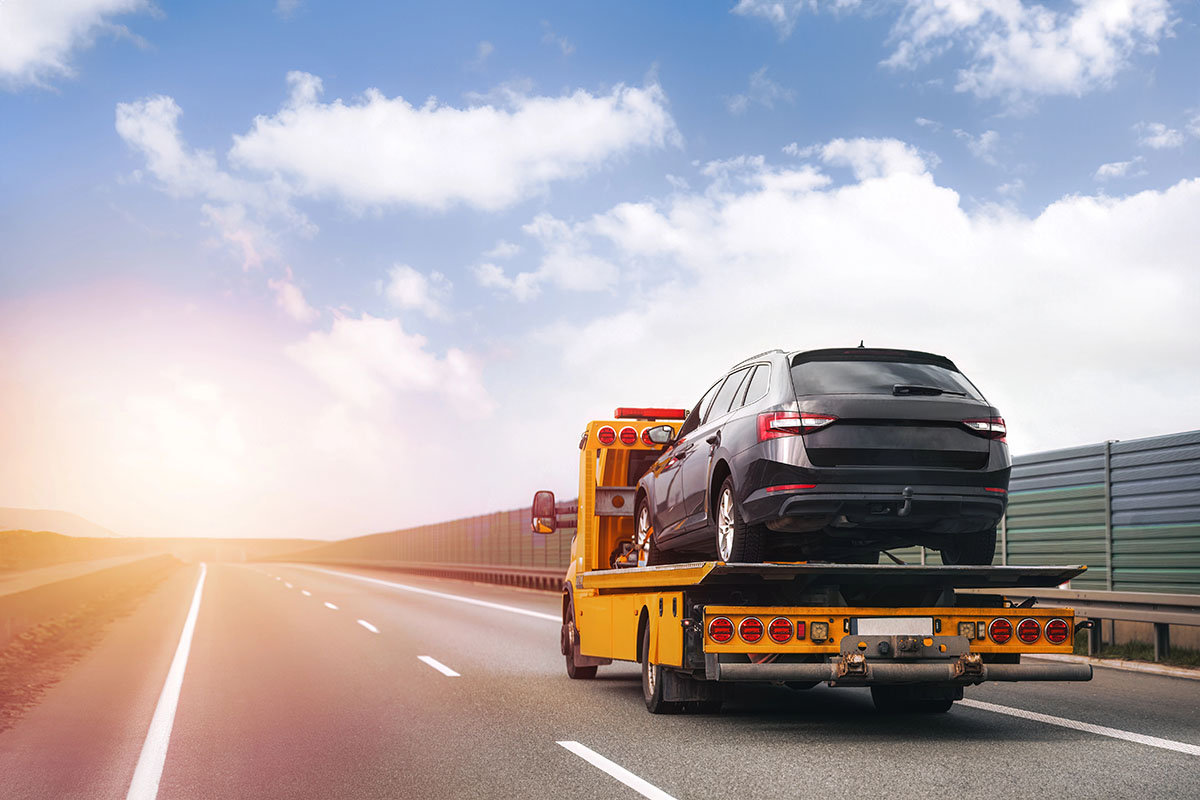
The rule for towing any AWD or full-time 4WD vehicle is straightforward: no wheels should touch the pavement. Professional towing companies do this two ways.
Flatbed Towing
This is the safest method. A flatbed truck uses a hydraulic bed that slides down to ground level. The vehicle gets winched onto the bed and secured with chains or straps. The car rides completely on top of the truck. No tire wear, and the drivetrain stays completely stationary. If you have an AWD vehicle, ask for a flatbed specifically.
Dollies
Sometimes a flatbed isn’t available, or the vehicle is stuck in a parking garage with a low ceiling where a flatbed can’t operate. In these cases, a standard wheel-lift tow truck works, but only with dollies.
The tow truck lifts one set of wheels (usually the front). The driver then places dollies (small, independent wheels) under the other set. This lifts the entire car off the ground. Same result as a flatbed: the car’s wheels don’t spin. It just takes more labor to set up.
The 4×4 Exception (And Why You Should Be Careful)

Trucks and SUVs with part-time 4WD systems often have a transfer case with a “Neutral” setting. In theory, shifting the transfer case into Neutral mechanically disconnects the wheels from the transmission. That’s how RV owners flat tow Jeeps behind their motorhomes.
During a breakdown, though, relying on this can be risky.
- Electronic Failure: Many modern 4×4 systems are electronic. If your battery is dead or you have an electrical fault, you might not be able to shift the transfer case into Neutral.
- User Error: If the transfer case isn’t fully disengaged, dragging the vehicle will still cause damage.
Unless you know your vehicle’s manual inside and out and are confident about the mechanical state of the transfer case, the safer approach is to treat it like an AWD vehicle and keep all wheels off the ground.
Preventing Towing-Related Damage
A few practical steps to protect your AWD or 4×4 vehicle:
- Keep your owner’s manual accessible or saved digitally.
- Read up on your vehicle’s recommended towing procedures before you need them.
- Don’t let untrained people tow your vehicle with ropes or chains.
- Request a flatbed tow when possible.
Knowing this stuff ahead of time means you can speak up for your vehicle when the situation is stressful.
FAQs
Can I tow my AWD car in Neutral with the engine off?
No. This is a common misconception. Putting the transmission in Neutral disconnects the engine from the wheels, but the internal transmission gears still spin if the wheels are turning. With the engine off, the transmission oil pump isn’t circulating fluid. The transmission will overheat and fail if towed for any real distance.
What if I only need to be towed a mile or two?
Damage to a viscous coupling or center differential can happen in less than a mile. The heat builds up fast. It’s never worth the risk to drag an AWD vehicle, even a short distance. Always wait for the right equipment.
Does flatbed towing cost more than a standard tow?
The base hook-up fee for a flatbed might be slightly higher than a standard wrecker, but the difference is small compared to the cost of a drivetrain repair. Many roadside assistance plans cover flatbed service when it’s required for your vehicle type.
How do I know if my car is AWD?
Look for badging on the rear of the car (AWD, 4Matic, Quattro, xDrive, SH-AWD). If you don’t see badges, check your owner’s manual. Still unsure? Tell the dispatch operator when you call for a tow. They can often figure out the drivetrain from the VIN or make and model.
Can a parking garage tow truck handle an AWD car?
Yes, but they need dollies. Parking garages are too low for flatbeds. A repo-style or wheel-lift truck will enter the garage, hook the car, and place dollies under the non-lifted wheels before moving the vehicle out.
Can all AWD vehicles be towed on a flatbed?
Yes. Flatbed towing works for nearly all AWD and 4×4 vehicles because it lifts all wheels off the ground and prevents drivetrain rotation.
Is it ever safe to tow an AWD vehicle with two wheels on the ground?
Generally no, unless the manufacturer specifically says it’s safe under certain conditions. Always check the owner’s manual first.
What happens if an AWD vehicle is towed incorrectly?

Improper towing can damage the transfer case, differentials, and other drivetrain components, leading to expensive repairs and reduced performance.
Do electric AWD vehicles have the same towing requirements?
Many electric vehicles with all-wheel drive also need flatbed towing. EV drivetrains work differently from traditional systems, so follow your manufacturer’s guidelines.
Should I always request a flatbed tow for my 4×4 truck?
In most cases, yes. Flatbed towing carries the least risk and is the recommended approach unless your specific vehicle supports safe alternatives.
The Right Support When You Need It
Breakdowns and accidents are stressful enough without worrying about a tow truck making things worse. As vehicles get more mechanically complex, there’s less room for error. Towing isn’t just about hooking a chain to a bumper anymore. It takes knowledge of drivetrain systems and the right equipment.

If you own an AWD or 4×4 vehicle, make sure your towing provider has flatbed capabilities and dolly-equipped wreckers. At Hi-Way Towing, our fleet handles any drivetrain configuration. We know your vehicle is an investment, and our process is built to transport it without adding to whatever damage brought you to the side of the road.